VL Blog
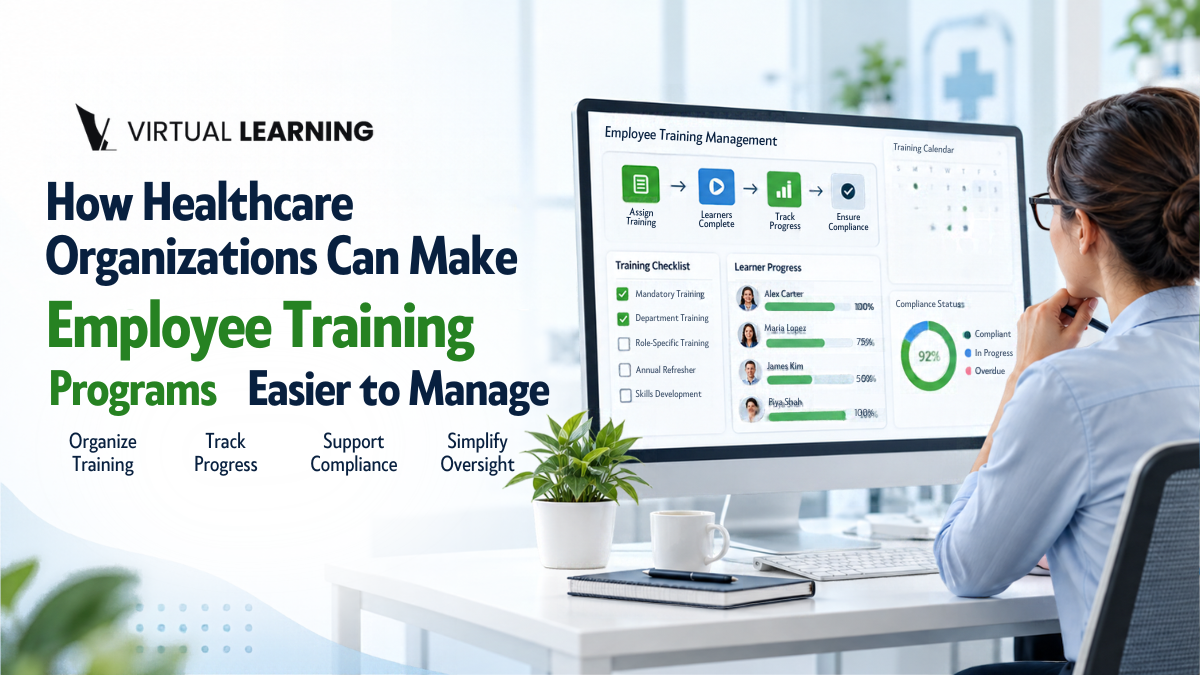
Employee training programs rarely become difficult because of the content itself. They become difficult because of everything around it: who is enrolled, who started, who finished, who needs a reminder, and where the record lives when someone asks for it. For a manager in home care, a vocational school, or a healthcare training provider, that administrative layer can quietly take more time than the training.
This article explains where that complexity comes from and how a centralized online structure can reduce fragmented processes. It focuses on how training is organized and administered, not only on how convenient it is for learners.
Why Employee Training Programs Get Harder to Manage as Teams Grow
A small group of employee training programs can be tracked with a spreadsheet and a few emails. That approach works until the organization adds a second cohort, a second program, or a second location. Each addition multiplies the follow-ups, the status checks, and the places where information is stored.
The pattern is common. Training starts as a simple task for one person. As the team grows, it becomes a recurring process involving several people, and nobody designed the process. It just accumulated. The result is a system that depends on individual habits: one manager’s spreadsheet, another’s inbox folder, a shared drive nobody fully trusts.
Where the Administrative Complexity Actually Comes From
Managers often describe the problem as “too much to track.” It is more useful to break that into specific sources, because each one can be addressed differently.
Multiple Learner Groups
New hires, existing staff, and different locations rarely train on the same schedule. Each group has its own start date, pace, and deadlines. Managing them in one list means constantly filtering to answer a simple question like “who still needs to finish?”
Different Programs With Different Needs
A healthcare organization may need Home Health Aide training for one group, Personal Care Assistant training for another, and ongoing Continuing Education for caregivers already on staff. Each program has its own requirements and its own definition of “complete.” Treating them as separate systems doubles the administrative work.
Enrollment and Follow-Ups
Getting someone into a program is only the first step. Someone must confirm access, notice who has not started, and send reminders. When follow-ups depend on memory or on a calendar note, they are the first thing to slip during a busy week.
Completion Status and Training Records
This is where fragmentation costs the most. When an auditor, a client, or a leader asks for proof that someone completed training, the manager has to reconstruct the answer from several places. Think of the last time you had to find a training record. How many places did you check before you found it?
What a Centralized Online Structure Changes
Centralizing does not mean adding a new layer of work. It means that the questions managers ask every week have one place to be answered.
In practical terms, a centralized online structure can help an organization:
- See learner groups in one view, instead of reconciling several lists.
- Keep multiple programs organized together, rather than running each as its own process.
- Check progress without asking for it, which reduces the number of manual follow-ups.
- Locate completion information quickly, so records are not rebuilt under pressure.
The goal is not to remove people from the process. It is to remove the searching, copying, and chasing that surround it, so managers spend their time on decisions rather than on tracking.
Questions to Ask Before Choosing How to Manage Training
Whether an organization keeps its current process or adopts a platform, these questions show where the real problems are:
- How many places do we check to know where a learner stands? More than two usually signals fragmentation.
- Can a manager see progress without contacting each learner?
- How are completion information and records stored, and who can find them?
- What happens when we add a new learner group or program? Does the process scale, or does it require rebuilding?
- How much manager time goes to reminders, status checks, and reports each month?
Counting the hours behind question five is often the most revealing step. Administrative time is part of the true cost of employee training programs, even when it never appears on an invoice.
Limits and Conditions to Keep in Mind
Organizing employee training programs online does not remove every requirement. Some programs include in-person or clinical components, and requirements vary by program and by state. A centralized system helps manage the online coursework and the tracking around it, but it does not replace hands-on practice where a program requires it. It also does not need to replace every HR or record system an organization already uses.
Before changing how you manage training, confirm the requirements that apply to your specific program and state with the relevant state agency or program documentation.
How Virtual Learning Fits Into Healthcare Training Programs
Virtual Learning is an online training platform for organizations, such as home care agencies, healthcare providers, and training providers, that need to deliver programs to multiple learners and keep training organized. Organizations can work with programs such as NJ CHHA, HHA Business, Phlebotomy, Continuing Education, and PCA within the platform.
For the administrative challenges described above, the relevant capabilities are:
- Online access to coursework for learners.
- Manager visibility into learner access and progress.
- Reusable licenses that can be assigned to future learners.
- Learner packages designed around different group sizes.
Details such as available programs, packages, and records features can depend on the program and on the agreement with each organization. A demo is the right place to confirm exactly what applies to yours.
Conclusion: Start With the Task That Costs You the Most Time
Making employee training programs easier to manage does not require fixing everything at once. Start by identifying the single task that consumes the most administrative time: tracking enrollments, sending reminders, checking completions, or preparing records.
Once you know which step it is, the next question is how that step would work inside a centralized system. Book a FREE Demo with Virtual Learning and bring that task with you, so you can see how the platform handles it, using your own program and learner volume as the example.
🌐 virtuallearnonline.com · 📩 info@virtuallearnonline.com · 📞 1-844-468-4788