VL Blog
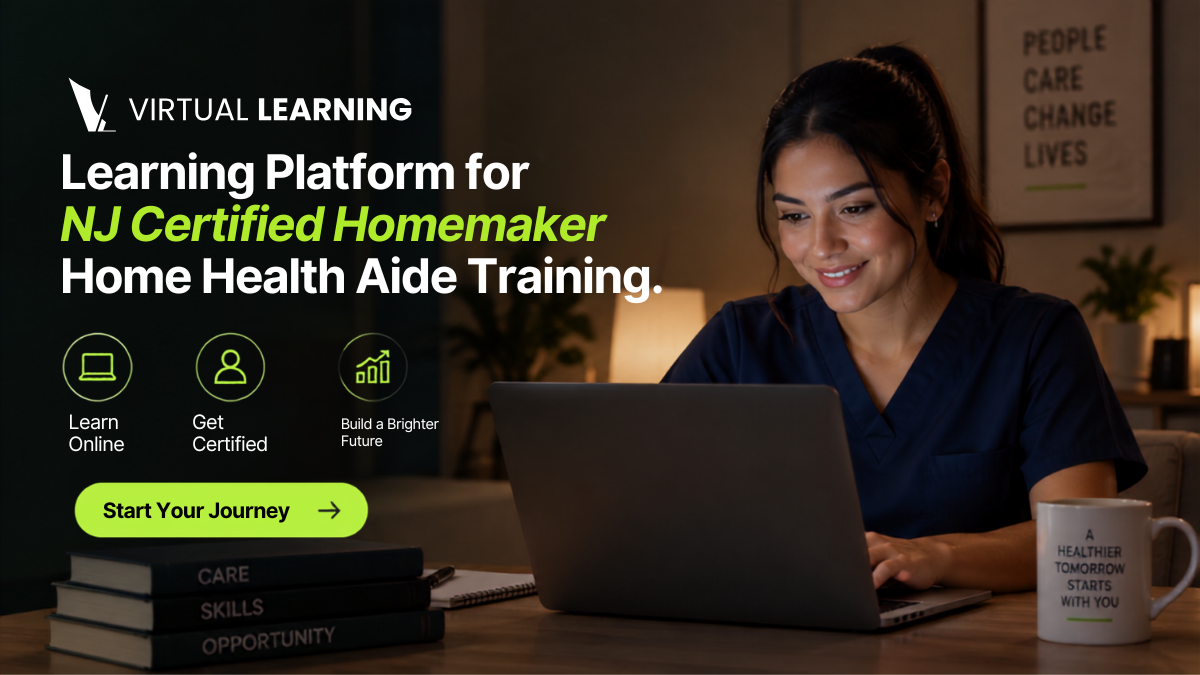
Choosing the right Learning Platform for an NJ Certified Homemaker Home Health Aide Program is no longer simply an educational decision. For New Jersey home care agencies, healthcare organizations, and approved training providers, it can influence how quickly new talent is prepared, how consistently students receive instruction, how efficiently administrators track progress, and ultimately how effectively a business can respond to growing demand for home-based care.
That business context matters because demand is moving in one clear direction. The U.S. Bureau of Labor Statistics projects employment of home health and personal care aides to grow 18% from 2025 through 2035, much faster than the average for all occupations. BLS also projects approximately 760,500 openings per year over the decade, driven by growth and the need to replace workers who leave the occupation or labor force.
U.S. Bureau of Labor Statistics: Home Health and Personal Care Aides
For a home care business, those numbers represent both an opportunity and a warning.
Demand for care creates room for growth. However, growth requires access to trained people. An agency can generate referrals, build relationships with hospitals, expand service areas, and invest heavily in marketing, but none of those activities create sustainable capacity if the organization cannot develop enough qualified aides to support new clients.
This is why the conversation around the NJ Certified Homemaker Home Health Aide Program should extend beyond the student.
It should also address the business.
How efficiently can an organization deliver training?
How much administrative work is required?
Can learning be standardized across multiple students?
These questions are particularly important in New Jersey because becoming a Certified Homemaker-Home Health Aide is not simply a matter of taking an informal online course.
The New Jersey Board of Nursing states that CHHAs are certified after successfully completing the required 76-hour training program, a competency evaluation, and a criminal history background check. The Board’s program information explains that the 76 hours consist of 60 hours of classroom instruction and 16 hours of clinical instruction in a skills laboratory or patient-care setting. The training curriculum, faculty, and facility also fall within Board requirements.
New Jersey Board of Nursing CHHA information
That regulatory structure makes the choice of training infrastructure especially important.
A generic online course library is not enough.
Healthcare organizations need a solution built around the realities of professional healthcare education, including structured coursework, learner management, progress visibility, state-specific requirements, and a clear distinction between what can be learned online and what must be completed through required clinical instruction.
That is where Virtual Learning becomes particularly relevant.
Virtual Learning offers an NJ Certified Homemaker Home Health Aide Business Program specifically for New Jersey training providers and healthcare organizations. Its NJ program page describes the solution as a scalable online training environment for home health aide students, with state-approved coursework, online access, team progress tracking, multi-staff licensing, business-level administration, and tools intended to make healthcare training easier to manage as an organization grows.
Explore Virtual Learning’s NJ Certified Homemaker Home Health Aide Program
Importantly, online learning should not be confused with eliminating the clinical component required in New Jersey. Virtual Learning’s individual NJ course page describes the structure as 60 hours of online coursework plus 16 hours of clinical site practice, aligning the digital learning component with the broader 76-hour framework described by the New Jersey Board of Nursing.
That distinction illustrates why a healthcare-specific Learning Platform can offer more strategic value than simply putting traditional course material on the internet.
The objective is not to replace everything with online learning.
The objective is to use technology where technology makes training more efficient while preserving the supervised, practical components required for professional preparation.
When that balance is built correctly, digital learning becomes infrastructure for growth.
For agencies that continually need qualified CHHAs, schools that want to expand training capacity, and healthcare organizations that need a more organized way to develop people, Virtual Learning provides a way to make training more scalable without treating education as an afterthought.
Why NJ CHHA Training Learning Platform Requires More Than Simply Offering a Course
At first glance, the NJ Certified Homemaker Home Health Aide Program appears straightforward.
Students need education.
A training provider delivers that education.
Students complete the requirements.
Qualified candidates proceed through the appropriate certification process.
However, looking at the process only from the learner’s perspective misses the operational complexity that exists behind every successful training program.
A training provider needs instructors.
It needs approved curriculum and compliant processes.
And if the provider intends to train increasing numbers of students, every one of those functions must continue working at greater scale.
That is why the most important question is not merely, “Can we teach CHHA students?”
The more strategic question is:
“Can we create a repeatable CHHA training operation?”
Those are not the same thing.
A talented instructor can teach a small group.
A well-designed organization can consistently develop many groups without allowing quality, visibility, or administration to collapse under increased volume.
This is one of the strongest business arguments for using a Learning Platform.
Training capacity can become a growth constraint
Consider a home care agency that is successfully attracting new clients.
Demand rises.
Recruiting receives more applications.
The organization wants to onboard more aides.
However, training capacity remains fixed.
Perhaps students need repeated emails containing different links and resources.
Suddenly, the agency’s growth is constrained not by demand but by its ability to prepare people.
This problem becomes more serious as the organization expands.
A system designed for ten students may fail at fifty.
A process that worked for fifty may become chaotic at two hundred.
Organizations frequently respond by adding administrative labor.
One more coordinator.
Another spreadsheet.
More emails.
Another meeting.
Another person responsible for checking progress.
That can work temporarily, but it does not necessarily solve the underlying structural problem.
The organization is scaling labor around an inefficient process instead of improving the process itself.
A Learning Platform changes the equation by centralizing parts of the educational workflow.
Virtual Learning, for example, describes its NJ business program as offering team progress tracking and the ability to train multiple aides through one business environment. Its program packages are built around reusable licenses, while the platform provides administrators with visibility into learner progress.
That matters because administrative efficiency has business value.
Every hour an employee spends searching for completion records, manually reminding students, organizing links, or reconciling separate learning files is an hour that cannot be used for higher-value work.
A coordinator could instead support struggling students.
A recruiter could focus on candidate quality.
An operations manager could prepare new hires for assignments.
A business leader could build referral relationships.
Technology does not eliminate the need for people.
It allows people to spend less time performing work that software can organize consistently.
Standardization matters in healthcare education in a learning platform
Scalability is not simply about training more students.
It is also about maintaining consistency while enrollment grows.
Healthcare education cannot depend entirely on what an individual instructor happens to remember that day.
Students in one group should not receive fundamentally different core preparation from students in another because different people managed their training.
Standardized content creates a foundation.
This does not mean removing instructors.
Quite the opposite.
When core theoretical material is organized through a Learning Platform, instructors can focus more attention on clarification, clinical application, student questions, practical competencies, and areas where human judgment adds meaningful educational value.
Technology handles repeatability.
Educators handle context.
That division can strengthen the learning model.
Imagine an instructor explaining the same foundational material repeatedly to multiple groups.
There is nothing wrong with repetition; teaching requires it.
However, when every element of content delivery depends on the instructor being available in real time, the instructor becomes the system.
If several cohorts need the same information, the same presentation must occur repeatedly.
A digital course changes the structure.
Foundational material can be available consistently.
Students can revisit difficult concepts.
Administrators can monitor participation.
Instructors can spend more of their time addressing what students do not understand rather than simply repeating what every student needs to hear.
That is a more scalable use of educational expertise.
Flexibility can remove unnecessary barriers
Home care training often attracts adults managing complex schedules.
Some may already work in healthcare.
Others may have family responsibilities.
Some depend on public transportation.
Some need to coordinate learning around employment.
A rigid classroom schedule can turn logistics into an unnecessary barrier.
That does not mean every portion of CHHA education should become self-directed or remote.
New Jersey’s required clinical instruction remains a practical component of the training program. The Board’s training materials specify the 60-hour classroom component and 16-hour clinical component, and Virtual Learning’s NJ course page similarly identifies 60 hours of online coursework and 16 hours of clinical site practice.
What digital delivery can change is the accessibility of appropriate coursework.
When students can access theoretical instruction through a Learning Platform, the organization gains more flexibility over how educational time is structured.
Instead of requiring every learning activity to happen at one physical location, digital coursework can reduce unnecessary travel and scheduling conflicts.
That flexibility has another important consequence.
It expands the potential recruiting funnel.
A home care agency that can connect suitable candidates with a more accessible training pathway may be able to engage people who would otherwise struggle to fit a traditional classroom schedule around existing responsibilities.
Virtual Learning explicitly positions its NJ CHHA program as a business tool that can increase recruiting potential for home care agencies by giving them a structured online training option for employees or students.
This is where education begins connecting directly with workforce strategy.
An agency that depends only on already-certified applicants competes for a limited pool.
An organization that can help suitable candidates move through approved training gains another pathway.
Instead of asking:
“Where can we find more certified aides?”
the business can also ask:
“How can we develop more qualified candidates?”
That is a much more powerful growth question.
Learning Platform Training can become part of recruitment rather than something that happens after it
Recruiting and training are frequently managed as separate departments.
Recruiters find candidates.
Training providers educate them.
Operations eventually assigns them.
But strategically, those functions are connected.
If the labor market contains more potential caregivers than certified caregivers, training capacity affects recruiting capacity.
A candidate may have the right attitude, communication skills, reliability, empathy, and interest in home care but lack CHHA certification.
Without a training pathway, that applicant may be rejected.
With the right pathway, the same candidate may become part of the future workforce.
That changes recruiting from credential hunting to talent development.
For agencies struggling with persistent staffing shortages, that distinction is significant.
It does not mean lowering standards.
It means creating a structured route through which appropriate candidates can meet those standards.
A Learning Platform supports that approach by helping organizations separate two limitations that are often confused.
The first is a lack of capable people.
The second is a lack of already-trained people.
Those problems require different strategies.
If capable people exist but cannot access efficient education, then improving the training pipeline may be more valuable than increasing recruitment advertising.
Learning Platform Regulation makes structure more important, not less
Healthcare organizations sometimes assume that technology makes training easier because it makes training less formal.
That is the wrong conclusion.
Technology should make compliant education easier to administer precisely because the underlying requirements remain formal.
The New Jersey Board of Nursing regulates Certified Homemaker-Home Health Aides. The Board explains that applicants must complete required education, competency evaluation, and background-check requirements. It also states that CHHAs must work for an appropriate New Jersey-licensed organization and are supervised by a registered professional nurse; they do not simply operate as independent private aides under the CHHA framework.
Therefore, a serious NJ CHHA program cannot be evaluated only according to how convenient the website looks.
Training providers should think about:
curriculum alignment, instructor responsibilities, clinical coordination, competency requirements, student documentation, program approval, administrative records, and the certification process that follows education.
Digital learning is valuable when it helps organize these responsibilities.
It becomes risky when organizations assume “online” means “informal.”
Virtual Learning’s advantage is that its NJ offering is built specifically around CHHA training rather than being a generic corporate LMS retrofitted with a few healthcare videos. The company’s site presents the program as a New Jersey-specific solution and describes its CHHA business program as approved by the New Jersey Board of Nursing. Organizations should still confirm current requirements and approval status directly with the Board as part of normal compliance due diligence, particularly because regulations and approval conditions can change.
The real product is not just coursework
When evaluating a Learning Platform, organizations frequently focus first on content.
What modules are included?
How many hours?
Which topics?
Those questions matter.
Virtual Learning’s NJ business page says its program covers topics including bloodborne pathogens and needlestick safety, child abuse, elder abuse, neglect, domestic violence, and additional areas relevant to training.
However, the business value of a platform extends beyond the modules themselves.
The platform is also a delivery mechanism.
- A tracking mechanism.
- A management mechanism.
- A scaling mechanism.
- A recruitment mechanism.
- And potentially a retention mechanism.
This distinction explains why two organizations using the same curriculum can produce very different operational results.
- One may depend on manual processes.
- The other may automate repeatable work.
- One may struggle to tell whether a student is falling behind.
- The other may have centralized progress visibility.
- One may need to rebuild training coordination for every new cohort.
- The other may reuse a structured process.
- One may view education as an expense required to satisfy regulations.
- The other may use education to create a larger and more sustainable staffing pipeline.
- The curriculum can be similar.
- The business model around it can be completely different.
That is why choosing the right Learning Platform should be treated as an operational decision, not merely a technology purchase.
How a Learning Platform Can Turn NJ CHHA Training Into a Business Capability
A high-performing Learning Platform should solve a problem larger than content delivery.
It should make the organization more capable.
For an NJ CHHA training provider or home care agency, that means the platform should help answer several business questions simultaneously.
Can we deliver appropriate online coursework while maintaining the required clinical structure?
Virtual Learning is designed around precisely those questions.
Its NJ Certified Homemaker Home Health Aide Business Program is positioned specifically for organizations rather than only individual students. The company describes the program as tailored to home care agencies, healthcare facilities, staffing providers, and training organizations that need a scalable route for HHA education.
That B2B focus matters.
An individual learner needs a course.
A business needs a system.
Centralized progress tracking changes management
Training becomes difficult to manage when information is fragmented.
- One administrator has a spreadsheet.
- An instructor has attendance records.
- Students receive materials through email.
- Another system stores assessments.
- Someone else follows up with incomplete learners.
As the number of students increases, the organization accumulates administrative risk.
- Information can become outdated.
- Follow-up becomes inconsistent.
- Managers may not know which record is current.
- A centralized Learning Platform reduces that fragmentation.
Virtual Learning states that its NJ business offering includes team progress tracking and a business dashboard with training analytics.
This creates more than convenience.
It creates visibility.
Visibility helps administrators identify where attention is needed.
A student progressing normally may require little intervention.
Another may need clarification before moving forward.
Without visibility, everyone receives approximately the same administrative attention.
With visibility, resources can be directed more intelligently.
This is one of the most important advantages of digital learning.
Automation does not need to reduce human support.
Used well, it allows human support to become more targeted.
Multi-user infrastructure makes growth more realistic
Training several hundred across recurring cohorts is different again.
Every additional student creates another record, another learning journey, another set of deadlines, another need for communication, and another person whose progress matters.
If the underlying system is manual, increased enrollment increases administrative complexity almost linearly.
Virtual Learning’s business model addresses this through multi-staff licensing and reusable license packages. Its current NJ program page lists packages based on 30, 60, and 90 reusable licenses.
The importance of this model is not simply pricing.
It is repeatability.
A business needs to know that when one cohort ends, the infrastructure can support the next.
Growth should not require rebuilding the training process every month.
This is particularly relevant for home care agencies because workforce demand does not occur once.
Clients change.
Caregivers leave.
New contracts arrive.
Service territories expand.
More referrals come in.
Employees need replacement.
The organization therefore needs a continuous talent pipeline, not a one-time training project.
A reusable Learning Platform can support that pipeline more effectively than disconnected, one-off educational arrangements.
Learning Platform Online access can increase training availability
Virtual Learning describes its platform as accessible from different devices and designed to allow learners to train online rather than requiring all instruction to occur through traditional classroom delivery.
- For an agency, this can improve availability.
- Suppose a promising candidate works part-time.
- Traditional class times may conflict.
- Another candidate may care for children.
- A digital component gives organizations more ways to support those learners.
- Again, the distinction with New Jersey’s 16-hour clinical requirement is essential.
- The Learning Platform can facilitate appropriate online theoretical coursework.
- It does not erase the supervised clinical component required by the state.
- This hybrid reality is a strength when communicated correctly.
- Theoretical knowledge benefits from accessibility and repeatability.
- Clinical instruction benefits from supervision, demonstration, observation, and feedback.
- The strongest program uses each environment for what it does best.
Student experience matters to business performance
Training providers often evaluate technology from an administrator’s perspective.
Is it easy for us to manage?
- That matters.
- But the student’s experience matters equally.
- A confusing platform creates questions.
- Questions create administrative work.
- Administrative work slows training.
- Slow training delays completion.
- Delayed completion can affect hiring and placement.
- Therefore, usability is not a cosmetic concern.
- It affects throughput.
- Students should understand where to begin.
- They should be able to navigate educational materials without repeatedly requesting technical support.
- A Learning Platform that reduces confusion makes the entire organization more efficient.
Virtual Learning’s positioning around accessible online education and business-level management is intended to connect these two sides of the experience: easier learning access for students and stronger oversight for the organization.
Training can become a recruiting offer
Home care agencies compete for many of the same candidates.
Salary matters.
Schedules matter.
Location matters.
Culture matters.
But training access can also matter.
Consider the difference between two recruiting messages.
The first says:
“We are hiring certified CHHAs.”
The second says:
“We are building our care team, and for appropriate candidates who need training, we have a structured CHHA development pathway.”
The second message creates a larger potential audience.
It does not eliminate certification requirements.
It helps candidates move toward meeting them.
Virtual Learning explicitly markets its NJ Certified Home Health Aide Business Program as a way for home care agencies to increase recruiting potential through training.
This is strategically important because the BLS outlook suggests that home-based care employers will continue competing for a large number of workers. Nationally, BLS projects approximately 847,300 additional home health and personal care aide jobs from 2025 to 2035.
When demand is that large, employers should not rely exclusively on finding finished talent.
Some will need to build talent.
Learning Platform: Training can influence retention after recruitment
There is another consequence.
An agency that provides development opportunities sends a different message to employees than one that interacts with them only when schedules need to be filled.
The first says:
“We need you to work.”
The second says:
“We need you to work, and we are also prepared to invest in your capability.”
That distinction can shape the employee relationship.
Virtual Learning positions professional development as one of the business outcomes of its training model.
Training alone cannot guarantee retention.
Poor management, unstable scheduling, uncompetitive compensation, lack of support, burnout, or difficult assignments can still cause strong employees to leave.
However, the absence of development creates another reason for disengagement.
When employees see no opportunity to learn, the role can become transactional.
Work a shift.
Get paid.
Repeat.
A development culture gives employees evidence that capability matters.
That can support retention when combined with strong management and fair employment practices.
A Learning Platform can connect recruiting, training, and operations
Perhaps the most important benefit is integration at the strategic level.
Businesses often organize recruiting, training, and operations separately.
Recruiting fills the funnel.
Training fulfills requirements.
Operations schedules workers.
But those functions are interdependent.
Recruiting cannot create capacity if training is too slow.
Training cannot create capacity if operations cannot place successful graduates.
Operations cannot sustain growth if recruiting and training do not maintain the talent pipeline.
A Learning Platform sits at the center of this system.
It converts candidates into trained people.
That makes it a bridge between talent acquisition and service delivery.
For a home care organization, that bridge directly affects revenue capacity.
Every client requires staff.
Every additional trained and qualified aide potentially expands the number of assignments the business can support.
Therefore, education can influence whether the organization is forced to decline work.
The training system may appear far removed from sales.
Operationally, it is not.
Marketing generates demand.
Sales converts demand.
Training helps create the capacity required to fulfill demand.
Without capacity, growth becomes theoretical.
Cost should be evaluated against operational value
Organizations naturally compare training costs.
That is reasonable.
However, cost-per-course can be a misleading metric.
A cheaper training method may require more administrative labor.
A classroom model may involve facility costs.
Manual tracking may consume coordinator time.
Rigid schedules may increase student attrition.
Limited training capacity may delay hiring.
Fragmented systems may require several software tools.
The correct financial question is therefore not simply: “How much does this course cost?”
It is: “What does it cost our organization to operate the entire training process?”
That calculation should include:
administrative hours, instructor time, technology, student support, training space, scheduling, reporting, delays, repeated manual tasks, and the opportunity cost of positions remaining unfilled.
Virtual Learning’s business licensing approach is designed to make costs more predictable across multiple learners. Its NJ program currently presents reusable license packages based on organizational training volume.
The purpose of a scalable model is to improve the economics as training volume increases.
That is particularly important for agencies that expect to hire continuously rather than train one small cohort and stop.
Healthcare-specific technology can be more valuable than generic LMS software
A generic Learning Platform can host almost anything.
Sales training.
Cybersecurity.
Leadership courses.
Company orientation.
Healthcare content.
That flexibility may be useful for large enterprises.
However, organizations focused specifically on healthcare training face another question:
How much work will be required to transform a generic platform into something appropriate for our needs?
Someone must understand state-specific requirements.
A healthcare-focused platform reduces that setup burden.
Virtual Learning already organizes its offering around healthcare business programs, including its NJ Certified Homemaker Home Health Aide Program, a broader Home Health Aide Business Program outside New Jersey, Continuing Education, Personal Care Assistant training in applicable markets, and Phlebotomy training.
For organizations whose core business is providing care or delivering healthcare education, that specialization can be more valuable than owning a highly customizable but empty LMS.
They do not necessarily need more software.
They need training capability.
Real home care operations show why training matters
Training becomes easier to understand when connected with what aides actually support in the field.
E&S Home Care Solutions, for example, describes its home care model as involving trained and certified care team members working within individualized plans established after professional assessment. Its services illustrate the real operational environment students may ultimately enter: helping clients remain safely at home while supporting daily routines and independence.
See how E&S Home Care Solutions structures home care services
That connection matters because CHHA training is not merely a credentialing exercise.
Graduates may eventually enter someone’s home.
They may assist with personal routines that require trust and dignity.
The quality of the training pipeline therefore affects real people.
Efficient education and meaningful education should not be treated as competing goals.
A strong Learning Platform should make it easier to achieve both.
New Jersey requirements should remain the source of truth
Digital training providers can simplify access, but they do not replace regulators.
Businesses evaluating an NJ CHHA program should always compare program claims with current New Jersey Board of Nursing information.
The Board’s CHHA resources and regulations should remain the authoritative reference for certification, program approval, training structure, supervision, and related requirements. The Division of Consumer Affairs’ CHHA regulations page was updated in 2026 and directs users to the applicable Nursing Regulations and Homemaker-Home Health Aide Regulations.
Review current New Jersey CHHA laws and regulations
This due diligence does not diminish the value of Virtual Learning.
It strengthens the purchasing process.
A professional training provider should want clients to understand the requirements.
Clear expectations reduce confusion.
They also help organizations recognize the difference between a credible healthcare Learning Platform and generic online training marketed with vague promises about certification.
NJ CHHA Training Decision Checklist
Before choosing a Learning Platform for an NJ Certified Homemaker Home Health Aide Program, healthcare leaders and training providers should evaluate more than course availability.
Use this checklist to determine whether the solution can support both education and business operations.
Regulatory alignment
- Does the program clearly address New Jersey CHHA requirements?
- Does it distinguish between online coursework and required clinical instruction?
- Can the provider explain how its course structure relates to the 76-hour state training framework?
- Are organizations encouraged to verify current requirements with the New Jersey Board of Nursing?
- Is the curriculum maintained as requirements evolve?
Platform functionality
- Can administrators monitor learner progress?
- Are assessment or quiz results available where relevant?
- Can multiple students be managed through one business environment?
- Is there a centralized dashboard?
- Does the system reduce reliance on manual spreadsheets?
- Can administrators quickly identify incomplete training?
Scalability
- Can the organization add more students without rebuilding the process?
- Are multi-user or reusable licenses available?
- Can one organization manage multiple learners efficiently?
- Does the pricing model make sense as enrollment increases?
- Could the system realistically support significantly more training volume next year?
Student accessibility
- Can learners access appropriate coursework remotely?
- Is content available through commonly used devices?
- Is navigation understandable?
- Can students revisit course material?
- Does the platform reduce unnecessary scheduling barriers?
- Is the difference between digital coursework and clinical requirements clearly communicated?
Educational quality
- Is the curriculum specific to healthcare?
- Does content reflect real issues relevant to home care?
- Is learning more substantial than clicking through slides?
- Can instructors focus on questions, understanding, and clinical application rather than repetitive administration?
- Does the system support consistent delivery across different cohorts?
Recruiting value
- Can the program create a pathway for suitable candidates who are not yet certified?
- Can the organization use training as part of its recruitment strategy?
- Could improved training access expand the candidate pool?
- Can the agency explain its development opportunity clearly to applicants?
Operational value
- How much administrative work does the platform eliminate?
- Does progress visibility improve follow-up?
- Can training records be managed more efficiently?
- Does the system shorten unnecessary delays between candidate interest and training progression?
- Can administrators spend less time coordinating routine tasks?
Business fit
- Is the product designed for organizations or primarily for individual students?
- Does the vendor understand healthcare training?
- Does the platform align with the organization’s expected enrollment volume?
- Can the provider demonstrate the system before the organization commits?
- Is implementation practical for the existing team?
Virtual Learning’s NJ program addresses many of these criteria through New Jersey-specific CHHA coursework, online access, team progress tracking, business analytics, multi-staff licensing, and reusable-license plans for organizations training at different volumes.
What a Strong NJ CHHA Training Setup Should Include
1. A clear 76-hour program structure. The New Jersey Board of Nursing’s training materials describe the required program as 60 hours of classroom instruction plus 16 hours of clinical instruction. Any organization evaluating digital training should understand exactly how the online and clinical components connect.
2. An accessible Learning Platform. Students should be able to reach appropriate theoretical coursework without unnecessary technical or scheduling friction. Accessibility supports participation, but convenience should never be confused with lowering professional requirements.
3. Business-level administration. The organization should be able to see more than an individual student’s screen. Administrators need progress visibility, learner management, and a practical way to oversee multiple students.
4. Repeatable enrollment and training processes. A system that works only when one highly organized employee personally manages every step is not genuinely scalable.
5. Clinical coordination. Because New Jersey includes required clinical instruction, organizations need a clear process for completing that portion of training. Online coursework is part of the solution, not the entire certification journey.
6. Consistent educational content. Core learning should not depend entirely on which instructor is available. Standardization creates a stronger foundation for instructors and learners.
7. Human support. Technology should make support more efficient, not remove it. Students still need instructors and administrators when questions arise.
8. Progress monitoring. Businesses should be able to identify who is advancing normally and who needs intervention. Virtual Learning includes team progress tracking and business-level training analytics within its NJ offering.
9. Scalable licensing. Organizations with ongoing recruiting needs should evaluate whether the training model can support recurring cohorts without producing continually increasing administrative complexity.
10. A direct connection to workforce strategy. Training should not exist in isolation. The organization should understand how the program supports recruiting, onboarding, employee development, client capacity, and long-term growth.
11. Regulatory awareness. Program operators should maintain a habit of reviewing official New Jersey Board of Nursing resources rather than relying exclusively on marketing claims or outdated training information.
12. A measurable business objective. Before implementing a Learning Platform, leadership should define success. Is the goal to train more candidates, reduce administrative time, improve completion, build a recruitment pipeline, support retention, increase service capacity, or achieve several of these outcomes simultaneously?
The last point is especially important.
Technology should not be purchased because digital training sounds modern.
It should solve a defined business problem.
When that problem is clear, the organization can evaluate Virtual Learning according to outcomes rather than features alone.
Why Virtual Learning Can Make NJ CHHA Training Part of a Larger Growth Strategy
The strongest reason to invest in a Learning Platform is not that online education is more modern than traditional education.
It is that a well-designed platform can connect education with business growth.
Healthcare organizations frequently treat growth as a sales problem.
Generate more inquiries.
Build referral partnerships.
Increase online visibility.
Expand service areas.
Win contracts.
All of those activities matter.
But there is another side of growth that receives less attention:
capacity.
A business cannot sustainably serve more clients than its workforce can support.
That means every growth plan contains an implied workforce plan.
And every workforce plan contains an implied training plan.
Consider what happens when marketing succeeds faster than staffing.
Phone calls increase.
Referrals arrive.
Families need services.
The agency has opportunities to convert.
But scheduling has limited availability.
Recruiters cannot find enough certified candidates.
Existing aides already carry full workloads.
Eventually, the agency must delay or decline cases.
At that point, training capacity is affecting revenue.
The connection is indirect, but it is real.
A stronger talent-development pipeline can increase the organization’s ability to convert demand into actual service.
That is why Virtual Learning should not be marketed merely as “online CHHA classes.”
That description is too small.
Virtual Learning can function as an operational layer connecting candidate recruitment, education, workforce development, and organizational growth.
The future of workforce development is build-and-buy, not buy-only
For years, many employers have approached staffing primarily through external acquisition.
Need a skill?
Hire someone who already has it.
Need a certification?
Find someone already certified.
Need more capacity?
Recruit more experienced workers.
This strategy will remain necessary.
However, an increasingly competitive labor market makes exclusive dependence on finished talent expensive.
The alternative is a build-and-buy model.
Hire qualified, experienced professionals when necessary.
At the same time, build internal pathways that help promising candidates and existing employees develop the capabilities the organization needs.
This is where a Learning Platform changes workforce economics.
Instead of every staffing shortage sending the organization back into the same labor market, some needs can be addressed through structured development.
For home care agencies, that can mean widening the recruitment conversation beyond candidates who arrive already holding every required credential.
Appropriate candidates can be introduced to a legitimate training pathway.
The organization does not eliminate standards.
It creates a route toward them.
That is a fundamentally different competitive position.
Virtual Learning can make training a service line
There is another opportunity for eligible training providers.
Education itself can become part of business strategy.
Virtual Learning’s homepage positions its business programs around the idea that training providers can expand services and create additional revenue opportunities.
That matters because an organization may initially look at a Learning Platform as a cost center.
But training capability can also produce value directly.
A qualified organization may use stronger educational infrastructure to serve more learners.
It may create a clearer pathway between education and employment.
The platform therefore has the potential to create both efficiency and opportunity.
The exact model will depend on the organization, its approvals, its regulatory responsibilities, and the services it is authorized to provide.
Still, the strategic principle remains:
Training does not need to sit at the edge of the business.
It can become one of the business’s capabilities.
The Learning Platform becomes more valuable as the organization grows
Many technologies provide approximately the same value regardless of company size.
A calculator works the same for one employee or one hundred.
Training infrastructure behaves differently.
The more learners an organization supports, the more valuable standardization and automation become.
If ten students each create ten minutes of avoidable administrative work, the problem is manageable.
If one thousand students each create ten minutes of avoidable administrative work, the organization has generated more than 166 hours of unnecessary activity.
Scale amplifies inefficiency.
It also amplifies efficiency.
This is why Virtual Learning’s multi-user design matters.
As training volume grows, administrators need a system that allows them to oversee groups rather than manually reconstruct each learner’s journey.
The business page’s reusable licensing structure also reflects a recurring-training model rather than one designed solely around isolated student purchases.
That difference is central to B2B value.
A home care business does not simply need to buy education.
It needs to manage education.
Better visibility can improve management decisions
Training data becomes more valuable when leadership does something with it.
Suppose administrators discover that a particular portion of coursework repeatedly creates difficulty.
That may indicate a need for instructor reinforcement.
Suppose one cohort progresses substantially more slowly than another.
Leadership can investigate why.
Suppose students regularly stop participating at the same point.
That can reveal an experience problem.
Suppose candidates who enter through the training pathway remain with the organization longer than external hires.
That can influence recruiting investment.
Suppose training volume increases while administrative hours remain relatively stable.
That demonstrates operational leverage.
None of these insights can emerge easily when learning data is scattered across emails, spreadsheets, and paper records.
A Learning Platform creates the possibility of treating education as measurable operations.
Virtual Learning’s real-time training analytics and team progress functionality are therefore more than convenience features.
They can provide the visibility needed to improve the training process itself.
Training quality ultimately affects the brand
- A home care agency’s brand does not live primarily in its logo.
- It lives in the experience clients receive.
- A family may never see the organization’s internal training system.
- They will notice whether different caregivers seem to operate according to consistent standards.
- Therefore, educational infrastructure can indirectly become brand infrastructure.
- Virtual Learning explicitly lists retention and reputation among the potential business benefits of its program.
- The claim makes strategic sense when framed carefully.
- A platform does not create a strong reputation automatically.
- People do.
- However, a better training system can help organizations give those people more consistent preparation.
- That consistency supports the conditions in which a stronger reputation can be built.
Training should continue after certification
One of the biggest mistakes organizations can make is viewing certification as the end of learning.
The New Jersey Board of Nursing’s own training-program information notes that initial CHHA training is designed to meet minimum state requirements and that training continues in the home care setting through scheduled agency in-service education and registered-nurse supervision.
That point deserves emphasis.
Certification establishes a threshold.
Professional development continues afterward.
The real work introduces complexity that no entry-level program can reproduce completely.
Caregivers encounter different personalities.
Different communication challenges.
Organizations should reinforce that experience with continuing education.
Virtual Learning offers a separate Continuing Education Program alongside its CHHA training solutions, creating a potential learning continuum rather than a one-time educational transaction.
For a business, that creates the possibility of a longer-term development relationship:
candidate, student, new aide, experienced employee, continuing learner.
That is strategically stronger than treating every phase independently.
New Jersey and Texas illustrate why training strategy must reflect local markets
New Jersey and Texas demonstrate both the scale of home-based care employment and the importance of state-specific thinking. In May 2024, BLS data showed approximately 105,460 home health and personal care aides in New Jersey and 314,610 in Texas, making direct-care employment economically significant in both markets; however, training and credentialing structures are not interchangeable across states. New Jersey has its specific CHHA framework under the Board of Nursing, while organizations entering other states must evaluate the rules applicable there rather than assuming that an NJ program transfers automatically. For a multi-market healthcare organization, the strategic advantage is therefore not one universal course but a Learning Platform capable of supporting different programs and workforce-development needs while preserving local regulatory awareness.
That local-versus-scalable balance is becoming increasingly important.
Healthcare organizations want systems that can grow.
Regulation remains local.
The winning training strategy must handle both realities simultaneously.
The 60-hour online component creates an obvious digital opportunity
The structure of the New Jersey CHHA program itself makes a Learning Platform relevant.
When 60 hours of the 76-hour training framework consist of classroom instruction, organizations have a substantial theoretical-learning component to manage. The 16-hour clinical component serves a different purpose and must be handled according to program and Board requirements.
Virtual Learning’s NJ course model specifically describes 60 hours of online coursework followed by 16 hours of clinical site practice.
From an instructional-design perspective, this creates an opportunity to place different types of learning in the environments best suited to them.
Online learning can support:
knowledge acquisition, review, structured modules, consistent presentation, quizzes, progress tracking, and flexible access.
Clinical instruction can support:
skills practice, observation, direct feedback, competency development, and practical application.
Trying to make the clinical environment perform all of the theoretical-learning work is inefficient.
Trying to make a digital environment replace required hands-on practice is inappropriate.
A hybrid structure respects the strengths of each.
Virtual Learning’s value lies in strengthening the digital side of that equation while giving organizations a scalable way to manage the learner journey.
The best platform reduces friction without lowering standards
This should be the benchmark for any healthcare-learning technology.
Convenience alone is not enough.
A training provider could make a course extremely easy by removing rigor.
That would not be progress.
The goal is to remove unnecessary friction, not meaningful requirements.
Unnecessary friction includes:
avoidable travel for coursework that can appropriately be delivered online,
repetitive administrative emails, multiple disconnected login systems, manual progress calculations, unclear student instructions, duplicated data entry, and difficulty locating educational material.
Meaningful requirements include:
learning, assessment, supervision, clinical instruction, competency, compliance, and professional accountability.
The role of a strong Learning Platform is to simplify the first category so organizations can concentrate more resources on the second.
That is a far stronger selling proposition than merely saying online training is easier.
It says:
We make the process easier to manage so the standards can remain serious.
Virtual Learning is especially compelling for organizations that expect recurring demand
Not every organization needs a business-level Learning Platform.
A person who wants to complete one isolated course has different needs.
But an agency that recruits continuously does.
A training provider operating multiple cohorts does.
A healthcare business expanding services does.
A company trying to convert suitable applicants into qualified workers does.
A school seeking a structured digital learning environment does.
For those organizations, buying isolated courses repeatedly can become operationally inefficient.
The better question is whether training can become a system.
Virtual Learning’s NJ business program is designed around this recurring need, with organizational accounts, multi-staff functionality, tracking, reusable licensing, and a free-trial/demo option that allows decision-makers to examine the environment before committing.
That last point matters.
Healthcare leaders should see the workflow.
A product page can list features.
A demonstration allows the organization to ask practical questions.
How will our students access the program? What will administrators see? How are groups managed? What can we track? How does licensing work? Where does clinical training fit? How will this integrate with our existing process? What support will our team receive?
Those questions transform a software purchase into an operational evaluation.
Virtual Learning can support a stronger talent pipeline
Ultimately, the strategic argument comes back to talent.
BLS projects hundreds of thousands of annual openings in home health and personal care aide occupations nationally.
Those openings will not be solved by job advertisements alone.
Healthcare organizations will need to attract people.
Develop people.
Retain people.
And continually refresh their skills.
Training sits inside all four challenges.
A candidate may choose an organization because it provides a pathway into healthcare.
A new employee may feel more confident because training was structured.
An experienced caregiver may remain more engaged because continuing education remains available.
An agency may grow because its training capacity keeps pace with new client demand.
A training provider may expand because digital infrastructure allows it to serve more learners without multiplying every administrative process.
This is why Virtual Learning should be positioned as more than educational technology.
It is an operational tool.
And, when implemented strategically, it can become a growth tool.
Organizations interested in understanding the service environment that trained CHHAs may ultimately enter can also explore E&S Home Care Solutions’ home care model, which provides a practical connection between education and the real-world delivery of care.
Explore E&S Home Care Solutions
For certification-related questions, New Jersey providers should continue using current Board of Nursing resources as the regulatory source of truth. Organizations dealing with expired CHHA certifications can also review licensure information from E&S Home Care Solutions as a secondary practical resource while confirming current requirements with the Board.
E&S Home Care Solutions CHHA/CNA licensure information
The larger takeaway is simple.
Healthcare education becomes more valuable when it is designed around the organization that has to deliver it repeatedly.
An NJ Certified Homemaker Home Health Aide Program is not just seventy-six hours on a calendar.
Behind those hours sits a much larger system.
- Recruitment.
- Enrollment.
- Instruction.
- Clinical practice.
- Progress.
- Competency.
- Certification.
- Employment.
- Supervision.
- Continuing education.
- Retention.
- Client capacity.
- Business growth.
Virtual Learning gives organizations a way to connect more of that journey through one healthcare-focused training infrastructure.
That is why the right Learning Platform can become a competitive advantage.
Not because online coursework eliminates clinical training.
It becomes an advantage because it allows organizations to manage the repeatable parts of education more intelligently.
When those processes become more efficient, educators can focus on teaching.
Recruiters can focus on candidates.
Managers can focus on people.
Operations can focus on service.
And leadership can focus on growth.
Virtual Learning: If your organization is trying to recruit more CHHAs, expand its training capacity, or build a more efficient pathway from candidate interest to workforce readiness, Virtual Learning gives you more than another online course. Its NJ Certified Homemaker Home Health Aide Business Program provides a healthcare-focused Learning Platform built around scalable online coursework, learner progress visibility, multi-user training, reusable licensing, and business-level administration while preserving the importance of New Jersey’s required clinical component. Instead of adding more spreadsheets, more manual follow-up, and more training complexity every time your organization grows, build an educational system designed to grow with you. Explore the NJ program and request a free demonstration to see how Virtual Learning can turn CHHA training into a stronger recruiting, development, and business-growth capability. Explore the NJ CHHA Business Program and request a demo
Frequently Asked Questions About the NJ Certified Homemaker Home Health Aide Program
What is an NJ Certified Homemaker Home Health Aide Program?
An NJ Certified Homemaker Home Health Aide Program prepares individuals for the education and competency requirements associated with becoming a Certified Homemaker-Home Health Aide in New Jersey.
The New Jersey Board of Nursing states that applicants must successfully complete the required training program, a competency evaluation, and a criminal history background check as part of the certification process.
The required training program consists of 76 hours, including 60 hours of classroom instruction and 16 hours of clinical instruction in a skills laboratory or patient-care setting.
A Learning Platform can support the classroom/theoretical side of this education by making appropriate coursework available online while helping training organizations organize learners and monitor progress.
Virtual Learning’s NJ CHHA course specifically describes its structure as 60 hours of online coursework plus 16 hours of clinical site practice.
Is the NJ Certified Homemaker Home Health Aide Program completely online?
No organization should describe the entire New Jersey CHHA training process as purely online if that wording implies that the required clinical component disappears.
The New Jersey Board of Nursing’s program materials identify 60 hours of classroom instruction and 16 hours of clinical instruction.
Virtual Learning uses online delivery for the 60-hour coursework component and identifies 16 hours of clinical site practice within its NJ course structure.
Therefore, the advantage of the Learning Platform is not that it replaces every form of in-person training.
Its advantage is that it makes the portion suitable for online education more accessible and scalable while the required practical component remains part of the training journey.
Who regulates Certified Homemaker-Home Health Aides in New Jersey?
Certified Homemaker-Home Health Aides are regulated by the New Jersey Board of Nursing, which operates within the Division of Consumer Affairs.
The Board provides information about CHHA certification, training, program requirements, renewal, and applicable regulations.
The Board also explains that CHHAs must work through an appropriate New Jersey-licensed organization and under registered-nurse supervision rather than simply working privately as independent CHHAs.
Because rules can change, healthcare organizations and prospective training providers should check current Board information rather than relying exclusively on old blogs or third-party summaries.
Why should a home care agency use a Learning Platform for CHHA training?
A home care agency does not only need educational content.
It may also need a repeatable way to develop candidates and employees.
A Learning Platform can centralize coursework, create consistency, allow more flexible access to suitable educational material, improve progress visibility, reduce repetitive administrative work, and make it easier to support multiple learners.
For agencies that recruit continuously, this can turn training into part of the talent pipeline.
Instead of competing only for workers who are already certified, an organization may be able to create a pathway for suitable candidates to obtain required preparation through an approved program.
Virtual Learning’s NJ business offering is specifically positioned around this B2B model and includes team progress tracking, business analytics, multi-staff licensing, and reusable training licenses.
How does Virtual Learning help NJ CHHA training providers?
Virtual Learning provides an NJ-specific business program intended to make CHHA training more scalable.
According to its program page, the Learning Platform offers online access, state-focused coursework, team progress tracking, multi-staff licensing, a business dashboard, and reusable-license packages based on training volume.
The value for training providers is therefore broader than hosting course content.
The platform can help organize recurring learner groups and give administrators better visibility into the training process.
For organizations with ongoing enrollment, this can reduce dependence on fragmented spreadsheets, separate resources, and repetitive manual follow-up.
The organization still retains responsibility for following New Jersey requirements, including the required clinical component and other Board requirements.
Can Virtual Learning help a home care agency recruit more caregivers?
It can support recruiting by creating an additional development pathway.
A home care agency that only recruits already-certified workers competes exclusively within the existing certified labor pool.
An agency connected with an appropriate CHHA training pathway may also be able to engage promising candidates who are interested in home care but still need required education.
Virtual Learning explicitly positions its NJ CHHA Business Program as a way for home care agencies to strengthen recruiting potential through training.
This approach can be particularly relevant as national demand for home health and personal care aides continues to grow. BLS projects employment in the occupation to increase 18% from 2025 through 2035 and estimates about 760,500 openings annually over the decade.
Training therefore becomes part of recruiting strategy rather than something completely separate from it.
What should an organization look for before choosing an NJ CHHA Learning Platform?
Start with regulatory alignment.
The platform should clearly explain the relationship between online coursework and New Jersey’s clinical requirements.
Then evaluate business functionality.
Look for centralized learner management, progress tracking, multi-user capabilities, accessible coursework, scalable licensing, reliable support, consistent educational content, and a clear process for integrating the platform into existing recruiting and training workflows.
Organizations should also ask whether the solution was built specifically for healthcare education or is simply a generic LMS.
Finally, evaluate the platform according to business outcomes.
Will it help train more people?
Will administration become easier?
Can training expand without administrative complexity increasing at the same rate?
Virtual Learning is designed around these organizational needs and offers a free demonstration of its NJ CHHA business environment so decision-makers can review the model before selecting a plan.