VL Blog
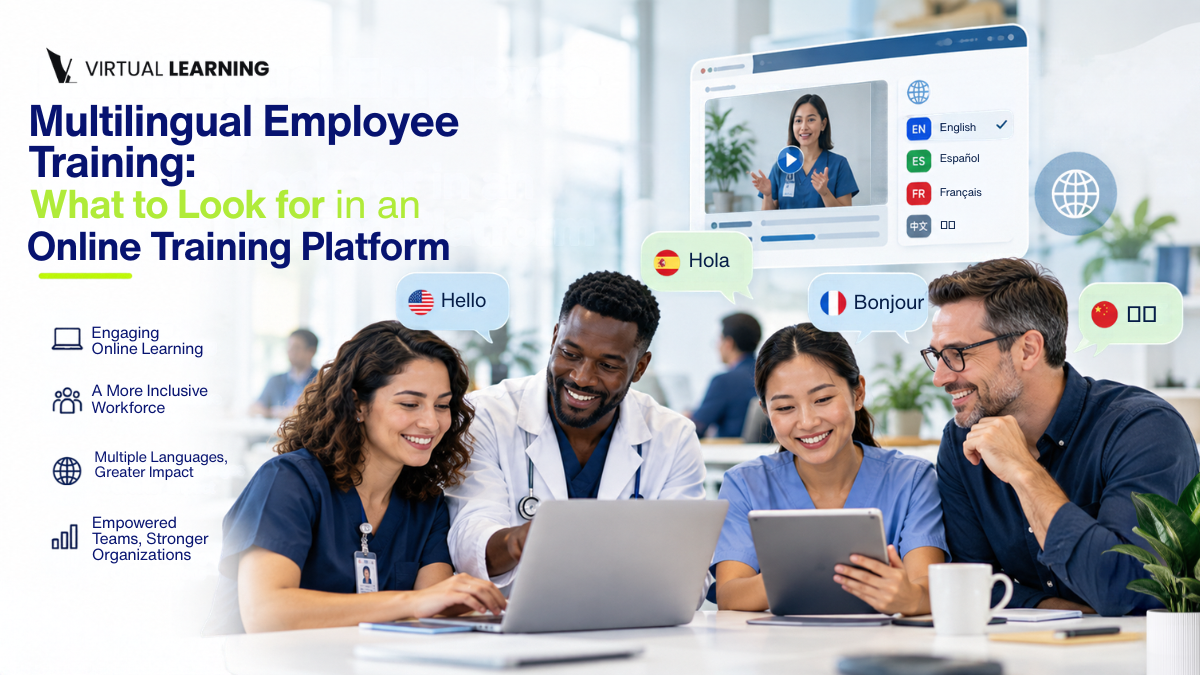
Multilingual employee training is becoming an operational requirement for healthcare organizations that employ diverse teams, serve Multilingual employee communities, and need employees to understand safety, compliance, caregiving, and professional-development content clearly.
For healthcare employers, the implications go far beyond convenience.
A safety module can lose much more.
Caregivers, home health aides, phlebotomy students, personal care assistants, administrators, and clinical support employees may need to understand subjects involving infection prevention, bloodborne pathogens, emergency procedures, documentation, patient safety, professional boundaries, body mechanics, abuse and neglect, privacy, and role-specific healthcare responsibilities.
In that environment, comprehension is not a cosmetic feature.
It is part of training quality.
Federal workplace-safety guidance reinforces this point. OSHA states that employers are responsible for providing safety training in a language and vocabulary employees can understand.
OSHA Employer Responsibilities
A truly Multilingual employee training system needs to consider whether the learner understands the terminology.
And, importantly, whether Multilingual employee education can remain organized rather than becoming an expanding collection of PDFs, videos, spreadsheets, and translated documents stored in different places.
This is why the choice of training technology matters.
Virtual Learning currently describes its platform as an all-in-one e-learning solution that is Multilingual employee and accessible and designed for training providers, schools, and businesses. Its healthcare-focused portfolio includes Home Health Aide business training, NJ Certified Homemaker Home Health Aide training, Continuing Education, Personal Care Assistant training, and Phlebotomy Technician education. Virtual Learn Online
That does not automatically mean every individual course, assessment, certification requirement, or piece of content is available in every displayed language. Organizations should verify language availability for the exact program they intend to purchase. However, the platform-level Multilingual employee design demonstrates something important: language accessibility has been considered as part of the user experience rather than added as an unrelated afterthought. Virtual Learn Online
For healthcare organizations, that approach can support a much larger workforce strategy.
The U.S. Bureau of Labor Statistics projects employment of home health and personal care aides to grow 18% between 2025 and 2035, adding approximately 847,300 jobs. BLS projects roughly 760,500 openings each year, on average, during that decade. Bureau of Labor Statistics
BLS: Home Health and Personal Care Aides
Healthcare businesses need more ways to identify capable people, educate them effectively, maintain consistent standards, and provide ongoing professional development.
Multilingual employee healthcare training can support that goal.
The strongest platforms do not simply ask:
What language does this employee speak?
They ask:
What does this employee need to understand, how can we make that understanding measurable, and how can the organization manage the learning process at scale?
The result is not merely translated training.
It is the possibility of building a more accessible training operation.
Why Multilingual Employee Training Is a Healthcare Operations Issue
- An employee speaks Spanish.
- Someone translates a document.
- A supervisor finds someone bilingual.
- A new hire speaks Haitian Creole.
- A coworker helps explain a policy.
- At small scale, these informal solutions may appear sufficient.
- At organizational scale, they become a risk.
Why?
One bilingual supervisor may explain a procedure accurately.
A translated document may remain in circulation after the English version has been updated.
A manager may assume an employee understood a module because the employee clicked “complete.”
The organization technically delivered training.
Comprehension remains uncertain.
That gap is the real problem.
Training completion and training understanding are not interchangeable.
OSHA’s training policy makes the distinction explicit. Its guidance states that training required by OSHA standards must be delivered in a way employees can understand, and its safety-management guidance recommends training at both the language and literacy level of workers. Asesoría en Seguridad y Salud
Consider bloodborne-pathogen training.
An employer may have a professionally designed course.
The videos are polished.
The slides are modern.
The completion rate is 100%.
What exactly did the completion metric prove?
That the employee accessed the course.
This is why multilingual employee training should be approached as an operational-control system, not merely a content feature.
The organization needs to create a reliable connection between information and action.
Language is one part of that connection.
Literacy is another.
A good platform brings those elements closer together.
Translation alone is too narrow.
An English sentence may be technically translated into Spanish while remaining difficult to understand.
Healthcare terminology creates additional complexity.
Some words have precise clinical or regulatory meaning.
Some concepts require explanation rather than word replacement.
Abbreviations may not transfer naturally.
Even reading level matters.
OSHA’s training-development guidance recommends writing training materials in everyday language appropriate to the participants and explicitly warns that content fails workers when it is understandable only to people with advanced education or specialized jargon knowledge. Asesoría en Seguridad y Salud
Multilingual = translated.
A stronger definition is:
Multilingual employee training is education designed so employees with different language backgrounds can access, understand, demonstrate, and apply the same essential workplace knowledge.
That definition changes purchasing decisions.
A platform that translates menu labels but leaves core course content in one language is not equivalent to a Multilingual employee educational solution.
The objective should be both:
learner comprehension and organizational control.
Virtual Learning’s architecture is relevant because its Multilingual employee positioning exists alongside business-management features.
For example, its Home Health Aide Business Program offers 100% online access, team progress tracking, multi-staff licensing, multiple-aide management through one business account, and professional-development capabilities. Virtual Learn Online
Its Continuing Education Program offers flexible online access, an administrative dashboard, reusable licenses, team and quiz tracking, and the ability to train multiple learners. Virtual Learn Online
This combination is strategically important.
The organization does not have to choose between language accessibility and management visibility.
A scalable platform should support both.
Multilingual employee training also influences recruiting.
Imagine two home care agencies competing for potential aides.
The first communicates:
“Training is in English. You will need to manage.”
The second communicates:
“We have a structured training environment designed to support a Multilingual employee workforce.”
Those statements create different candidate experiences.
A capable worker may have years of caregiving experience, strong interpersonal skills, reliability, patience, and cultural knowledge yet feel less confident learning technical material in English.
That distinction is essential.
Language accessibility should not mean easier standards.
It should mean a clearer pathway to the same standards.
If one employee takes a safety assessment in English and another takes an appropriately translated version, the goal should remain identical:
Does the employee understand the safety requirement?
Language should not become the competency being accidentally tested when the actual competency is something else.
Recruiting only from workers who already possess every credential, understand every technical term in English, and fit every existing training process limits supply.
The organization can identify people with potential and help them acquire the required knowledge.
Virtual Learning’s own mission is centered on anticipating labor-market needs and providing vocational training that supports businesses as workforce demand changes. Virtual Learn Online
That aligns naturally with Multilingual employee workforce development.
A business expecting labor demand to grow should not merely ask where today’s employees will come from.
It should ask how tomorrow’s employees will be developed.
There is also a retention argument.
Employees judge organizations partly by the friction they encounter.
A worker who repeatedly needs another employee to explain mandatory training may feel dependent.
An employee who understands the subject but struggles with English testing may conclude that advancement is unrealistic.
These experiences can shape how people perceive their future inside the company.
A Multilingual employee training platform can reduce some of that friction.
It tells employees:
The organization expects you to learn.
That does not guarantee retention.
Compensation matters.
Schedules matter.
Leadership matters.
Workload matters.
Recognition matters.
Career progression matters.
Nevertheless, development belongs in the same conversation.
People are more likely to see value in training when training allows them to demonstrate what they know rather than continually confront avoidable language barriers.
The argument becomes even stronger when healthcare organizations serve multilingual clients.
A Multilingual employee workforce can be an operational advantage.
E&S Home Care Solutions provides a practical example. Its Certified Home Health Aide service page states that the organization employs a diverse group of healthcare professionals and currently serves families speaking languages including English, Spanish, Polish, Russian, French, and Arabic. E&S Home Care Solutions
See E&S Home Care Solutions Certified Home Health Aide services
That kind of service environment illustrates why language cannot be viewed only as an employee issue.
Healthcare organizations may recruit diverse employees because those employees strengthen communication with equally diverse client communities.
The training system should support rather than undermine that advantage.
Someone who speaks Arabic fluently may communicate exceptionally well with an Arabic-speaking family.
A Spanish-speaking caregiver may help a Spanish-speaking client feel more comfortable.
Therefore, multilingual employee development can serve two business objectives at once:
expand workforce accessibility,
and strengthen the organization’s ability to serve diverse communities.
AHRQ’s patient-safety resources show why language capability can matter downstream. Its guide for hospitals reports that language barriers can contribute to communication problems and patient-safety risks for people with limited English proficiency. AHRQ recommends training healthcare teams—including nurses, technicians, frontline staff, physicians, and interpreters—on communication practices relevant to LEP and culturally diverse patients. AHRQ
This is a separate issue from the language in which employees receive their own workplace training.
The distinction matters.
An organization may need to do both:
train employees in a language they understand,
and train employees to work safely with patients or clients who have different language needs.
A sophisticated platform strategy should account for both types of language competency.
Multilingual education also needs version control.
This issue is easy to overlook.
Suppose an organization has one English course and four translated versions.
A policy changes.
The English course is updated immediately.
What happens to the others?
Every additional language increases the importance of centralized governance.
This is where a structured online platform can provide major value.
The platform can become the designated learning environment.
Employees access assigned courses through the same system.
Administrators manage the learner population centrally.
Completion data stays connected to employee accounts.
Updates can be managed more intentionally.
Virtual Learning’s business-plan structure supports group administration. Its FAQ states that business plans are designed for companies and group leaders and include an administrative panel to manage courses for trainees. Its reporting tools also allow administrators to locate completed courses and retrieve certificates. Virtual Learn Online
Five hundred are not.
Assessment quality deserves equal attention.
Imagine that a course has been translated beautifully.
The assessment has not.
The score suggests low competency.
The real problem is assessment language.
Now consider the opposite.
An assessment translation accidentally makes one answer more obvious than in the original.
The employee receives a high score.
The language version is not measuring the same difficulty.
Both scenarios undermine training data.
Are all questions translated?
Can administrators compare completion across language versions?
Are updates synchronized?
Can employees ask questions when terminology is unclear?
For some OSHA-regulated training, opportunities for interaction matter as well. For example, OSHA’s bloodborne-pathogen guidance requires an opportunity for interactive questions and answers and warns that videos or computer programs alone are not sufficient when the applicable standard requires interaction. Asesoría en Seguridad y Salud
Its value lies in organizing and scaling digital healthcare education.
Technology creates leverage.
People create context.
Accessibility should extend beyond language.
Multilingual content does not automatically help a learner with low literacy.
Neither does it automatically help someone with vision limitations.
Or hearing limitations.
The question is not merely:
“Can employees change the language?”
It is:
“Can employees actually use the platform?”
Virtual Learning’s homepage explicitly describes its e-learning solution as both multilingual and accessible. Virtual Learn Online
A buyer should take that claim as the beginning of the evaluation rather than the end.
Use the demo.
Test representative employees.
Try different devices.
Review the exact language versions needed.
Check captions.
Review reading level.
Evaluate quizzes.
Test login flows.
Ask a bilingual subject-matter expert to inspect high-risk content.
Watch what real learners do.
A platform demonstration should become a miniature implementation test.
That is especially useful for multilingual environments because decision-makers may not personally speak all the languages employees use.
A training administrator who speaks only English cannot reliably assess a Spanish translation alone.
The organization may need bilingual supervisors, instructors, professional translators, or subject-matter reviewers to validate important content.
Technology makes distribution easier.
It does not remove quality control.
What a Strong Multilingual Employee Training Platform Must Do Beyond Translation
A healthcare organization should evaluate multilingual training through five lenses:
understanding, consistency, administration, scalability, and business value.
If any one of those fails, the training model becomes weaker.
Start with understanding.
Employees need to comprehend the material.
That sounds obvious.
Yet many organizations measure everything except comprehension.
They know how many people logged in.
Those metrics are useful.
But an organization should also ask:
Can a supervisor observe the expected behavior afterward?
This is where assessment and coaching become important.
OSHA guidance specifically notes that online training can be supplemented with knowledge checks and discussions to help employers determine whether workers understood the material. Asesoría en Seguridad y Salud
That principle should influence multilingual program design.
An employee’s preferred training language should make comprehension easier to demonstrate.
It should not make assessment disappear.
Next comes consistency.
Every employee should receive the same essential message.
That does not mean every word must look identical across languages.
Good translation may require different sentence structures.
Examples may need adaptation.
But the learning objective should remain consistent.
If one group is tested on a concept, comparable groups should not unknowingly receive an easier or incomplete curriculum.
Consistency protects both employees and employers.
It also allows the training platform to function as an organizational standard.
Without consistency, the organization effectively operates several separate training systems.
Administrative visibility comes next.
A healthcare business should not need one dashboard for English employees and another spreadsheet for Spanish employees.
Language should be an attribute of the learner experience—not a reason to fragment administration.
The company should be able to answer:
Who is enrolled?
What course is assigned?
What language is appropriate?
Who may require retraining?
Can certificates be retrieved?
Are records centralized?
Virtual Learning already provides several pieces of this management structure across its business programs.
Its HHA program includes team progress tracking and multiple-staff licensing. Virtual Learn Online
Its CE program includes an admin dashboard, team and quiz tracking, reusable licenses, and multiple-student training. Virtual Learn Online
Its PCA program combines multilingual positioning with a progress-tracking dashboard, 24/7 access, multiple-aide management, and real-time completion monitoring. Virtual Learn Online
This is what makes Virtual Learning commercially relevant to the multilingual problem.
The selling point is not simply:
“We support multiple languages.”
It is:
“We can help organizations manage healthcare training while making that training more accessible to a multilingual workforce.”
Those are very different value propositions.
The second is much stronger.
Scalability is the fourth lens.
Imagine a training provider with 20 learners.
Manual translation may appear manageable.
Now imagine 200.
Every translated email, course update, completion reminder, certificate question, quiz issue, and student-support request grows with enrollment.
An organization cannot solve multilingual scale through heroic administrative effort.
It needs standardized infrastructure.
Virtual Learning’s group-oriented licensing is useful here.
Its HHA Business Program currently offers reusable-license plans designed around multiple learners, while the CE and PCA programs similarly use group licensing and centralized management. Virtual Learn Online
The strategic principle is more durable:
A multilingual training system should become more efficient as the number of learners increases, not progressively harder to manage.
That is what software should solve.
The fifth lens is business value.
Why is the organization investing in multilingual employee training?
Perhaps the organization wants to recruit from a larger candidate pool.
The platform should be evaluated against those outcomes.
A generic LMS may offer excellent language technology.
Virtual Learning already starts with healthcare programs.
Its portfolio includes HHA, CHHA, PCA, Continuing Education, and Phlebotomy. Virtual Learn Online
This reduces one layer of implementation complexity.
However, healthcare leaders should verify exactly what “multilingual” means for the program they are buying.
This is an important purchasing discipline.
A platform can be multilingual at several different levels:
the website interface,
navigation,
learner account,
help documentation,
captions,
subtitles,
course text,
audio narration,
assessments,
certificates,
administrator dashboard,
or customer support.
These are not identical.
For example, Virtual Learning’s user area currently displays a substantial list of language options, and the homepage describes the overall platform as multilingual. Virtual Learn Online
The New York PCA business program is also explicitly described as multilingual. Virtual Learn Online
Nevertheless, an organization should not infer that every Virtual Learning program has every course component translated into every interface language.
Ask.
Which languages are available for this exact program?
Are lessons translated?
Are quizzes translated?
What about videos?
Are subtitles available?
Are assessments equivalent?
Is the admin environment multilingual?
How are updates handled?
Can additional languages be supported?
What does customization include?
Those questions improve the buying process and protect both parties from assumptions.
Multilingual does not mean one employee should automatically train in only one language forever.
Bilingual employees may want flexibility.
A worker may prefer Spanish for complex clinical topics but feel comfortable reading general company communication in English.
Another learner may want to switch between versions to understand terminology used in the workplace.
A thoughtful platform can potentially support this more naturally than fixed printed materials.
However, switching languages during regulated or assessed coursework may have program-specific implications.
Again, organizations should clarify exact platform behavior rather than assuming.
Technical healthcare vocabulary deserves special attention.
Translation becomes difficult when ordinary language intersects with specialized terminology.
Take infection control.
Words such as “exposure,” “contamination,” “precautions,” “transmission,” and “disinfection” may be translated accurately yet still require explanation.
Similarly, phlebotomy contains terms related to venipuncture, specimens, blood cultures, veins, and safety procedures.
Virtual Learning’s Phlebotomy Technician Program covers topics including HIPAA, veins, blood, venipunctures, blood cultures, and related subject matter. The business program also includes an admin dashboard, reusable licensing, 24/7 access, and team and quiz tracking. Virtual Learn Online
For material like this, translation should be reviewed for technical meaning.
A fluent translator who does not understand healthcare terminology may make errors.
A healthcare professional who is not fluent in the target language may also miss linguistic problems.
High-quality multilingual healthcare training may therefore require collaboration between linguistic and subject-matter expertise.
That principle becomes increasingly important as the material becomes more safety-critical.
Cultural relevance matters too, but it should not become stereotyping.
A multilingual workforce is not a collection of cultural caricatures.
Two Spanish-speaking employees may come from completely different countries, professional backgrounds, education levels, and family cultures.
Language provides access.
It does not tell the organization everything about the learner.
Training should therefore avoid assuming that translated content needs exaggerated cultural customization based on stereotypes.
Instead, examples should be understandable, respectful, and relevant to work.
The objective is to remove barriers—not replace one set of assumptions with another.
Mobile access can further strengthen multilingual training.
Some employees may not regularly use desktop computers.
Home care staff are especially mobile.
They travel between client homes.
They may not visit the office daily.
BLS notes that home health and personal care aides frequently work in clients’ homes and may have varying schedules, including evenings and weekends. Bureau of Labor Statistics
Virtual Learning’s HHA business offering allows employees to train online and states that staff can train from different devices, while the PCA program specifies access by computer, tablet, or smartphone. Virtual Learn Online
This matters for multilingual access because the best translation has little value if employees cannot practically reach it.
A strong system reduces several barriers simultaneously:
language,
location,
schedule,
and device access.
That combination can make training more realistic for distributed healthcare teams.
Multilingual Employee Training Platform Checklist
Before selecting an online platform, healthcare organizations should evaluate the complete multilingual learning experience rather than trusting a single “multiple languages available” claim.
Language coverage
- Which languages does the platform support at the interface level?
- Which languages are available for the exact healthcare courses the organization needs?
- Are quizzes and assessments translated?
- Are videos captioned or narrated where appropriate?
- Are certificates and learner instructions available consistently?
- Does the provider clearly distinguish platform-language options from full course-language availability?
Translation quality
- Who reviews translated healthcare content?
- Is technical terminology checked by knowledgeable reviewers?
- Are safety-critical instructions independently validated?
- Does the translation preserve the original learning objective?
- Can employees report unclear language?
Comprehension
- Are courses written at an appropriate literacy level?
- Do assessments verify understanding?
- Can employees ask questions when training requirements call for interaction?
- Can managers identify learners who may need additional support?
- Is completion treated as one signal rather than automatic proof of competency?
Centralized administration
- Can multilingual learners be managed from the same business account?
- Can administrators track progress regardless of language?
- Are quiz results visible?
- Can certificates be retrieved centrally?
- Does language accessibility create a unified training operation rather than several disconnected systems?
Healthcare relevance
- Are programs built for healthcare organizations?
- Does the platform support training relevant to aides, caregivers, clinical staff, or vocational learners?
- Are healthcare terminology and real-world situations reflected in the material?
- Does the platform understand that some programs require clinical or practical instruction beyond online coursework?
Compliance alignment
- Does the organization know which OSHA, state, licensing, or program-specific requirements apply?
- Is required safety training understandable to employees?
- Are applicable language and literacy obligations addressed?
Accessibility
- Can employees use commonly available devices?
- Is the interface easy to navigate?
- Are learners with lower digital confidence supported?
- Are text, audio, captions, and visual elements usable?
- Is multilingual access part of a broader accessibility strategy?
Version control
- Can administrators identify the current version?
- Is someone accountable for translation governance?
Scalability
- Can the platform support hundreds of multilingual learners?
- Does the licensing model work for recurring cohorts?
- Can additional employees be added without rebuilding training workflows?
- Can organizations manage multiple roles or programs through a common environment?
Reporting
- Can leadership compare completion rates?
- Can managers identify where learners are struggling?
- Can training data support coaching and development decisions?
- Are reports useful for organizational oversight?
Customization
- Can learning pathways be adapted to different roles?
- Can onboarding be personalized?
- Can specific modules be assigned to particular groups?
- Can the provider support organizational requirements as the business grows?
Employee experience
- Can employees select or access the appropriate language without excessive administrative intervention?
- Are instructions clear?
- Can learners resume courses easily?
- Do employees know who to contact for support?
- Does the learning system feel like a professional development resource rather than another obstacle?
Virtual Learning already addresses several of these categories through its multilingual platform positioning, healthcare-specific programs, group administration, progress tracking, quiz tracking, online access, customizable onboarding options, and reusable-license models. Virtual Learn Online
Organizations should use its free-demo opportunities to test the exact multilingual experience they need before implementation.
12 Things a Healthcare Organization Should Test Before Choosing a Platform
- Ask three real employees to use the platform. A marketing demonstration cannot reproduce every learner’s experience. Include employees with different language preferences, technical confidence levels, ages, and healthcare backgrounds.
- Review an entire course in the target language. Do not evaluate only the home page. Open lessons, videos, quizzes, instructions, assessment screens, and completion messages.
- Compare the translated version with the source version. The essential concepts should remain equivalent even when wording differs.
- Test healthcare terminology. Ask bilingual healthcare professionals to inspect technical language, especially content related to safety, infection prevention, clinical procedures, emergencies, and legal responsibilities.
- Take the assessment. A multilingual course is incomplete if the quiz creates language problems the lesson solved.
- Use the administrator dashboard. Verify that multilingual access does not produce separate, difficult-to-manage reporting processes.
- Check mobile usability. Employees may use phones or tablets rather than office computers. Test the course on realistic devices.
- Test employee support. Ask how learners get help when they encounter a language, login, content, or assessment issue.
- Ask how updates are synchronized. A multilingual platform should have a process for preventing outdated translations from remaining active after content changes.
- Review the licensing model at future scale. Do not evaluate cost only for today’s team. Estimate what happens if enrollment doubles or triples.
- Verify program-specific requirements. Online and multilingual access do not eliminate clinical, practical, state, federal, or certification obligations that may apply to particular healthcare training programs.
- Define what success will look like. Higher completion? Faster onboarding? Fewer requests for informal translation? Improved knowledge-check results? More diverse recruiting? Better continuing-education participation? Lower administrative workload? The organization needs a baseline before it can know whether the platform improved anything.
Multilingual Training Can Become Workforce Infrastructure, Not Just a Language Feature
The strongest argument for multilingual training is not linguistic.
It is strategic.
Healthcare organizations are entering a period in which workforce development will become increasingly difficult to separate from business growth.
BLS projects approximately 847,300 additional home health and personal care aide positions between 2025 and 2035, making the occupation the largest projected source of numeric job growth among the occupations listed in its current projections. Bureau of Labor Statistics
At the industry level, BLS projects employment in services for older adults and people with disabilities to grow by approximately 625,400 jobs from 2025 to 2035, while home healthcare services are projected to add roughly 336,300 jobs. Bureau of Labor Statistics
Demand is therefore expanding on multiple fronts.
Organizations can respond in two ways.
They can compete more aggressively for the exact same workers.
Or they can also improve their ability to develop talent.
Both will be necessary.
Recruiting brings people into the organization.
Training makes them more capable.
Continuing education keeps knowledge current.
Professional development increases future capability.
Language access determines how many employees can realistically participate in that system.
Viewed this way, multilingual employee training is not a translation project.
It is workforce infrastructure.
That changes the economic argument.
Suppose an organization spends heavily on recruiting.
Candidates arrive.
Some speak English fluently.
Others use English effectively in everyday conversation but prefer another language for technical learning.
Another group includes excellent caregivers whose written English develops more slowly than their practical ability.
If the organization provides only complex English-language training, it creates an additional filter.
The filter may have nothing to do with the employee’s actual caregiving potential.
Some depend on informal translation.
Managers spend time explaining course material.
Training coordinators receive repetitive questions.
Completion slows.
The business concludes that recruiting is difficult.
Part of the problem may actually be training accessibility.
Now imagine the same organization has a multilingual healthcare training system.
Appropriate learners access supported languages.
Administrators continue tracking everyone centrally.
Assessments measure subject understanding.
Managers provide role-specific coaching.
Clinical instruction still occurs where required.
The organization has not lowered expectations.
It has removed an unrelated barrier.
This changes the workforce equation.
The business can recruit for capability and develop for competency.
That is particularly important when labor supply is constrained.
Organizations that can develop people have more options than organizations that can only buy finished talent from the external market.
Virtual Learning can support that development model because it combines healthcare-specific education with business-level training infrastructure.
Its platform is explicitly positioned as multilingual and accessible. Virtual Learn Online
Its HHA offering is designed for agencies, healthcare facilities, staffing providers, and training providers that need scalable online education. Virtual Learn Online
Its Continuing Education Program extends development beyond initial onboarding. Virtual Learn Online
Its PCA offering demonstrates how multilingual delivery can be embedded directly into a state-specific healthcare business program. Virtual Learn Online
Together, these capabilities allow Virtual Learning to be positioned as more than a course vendor.
It can become the educational layer of a healthcare organization’s workforce strategy.
That layer becomes more valuable as the company grows.
Small organizations can survive through informal knowledge.
A supervisor remembers who completed training.
An experienced employee translates something for a new hire.
A manager stores certificates in a local folder.
Everyone knows who needs help.
Growth makes those systems fragile.
At multiple locations, different offices create their own processes.
Training quality diverges.
Language support becomes inconsistent.
Documentation becomes fragmented.
The organization accumulates operational risk.
Digital learning infrastructure creates a shared standard.
Everyone may not have the same role.
But the system creates one place where training can be organized.
That is the real meaning of scalability.
Standardization does not require sameness.
It requires governance.
A good multilingual Learning Platform allows the organization to standardize:
quality expectations,
administrative oversight,
progress tracking,
assessment principles,
training records,
and employee-development processes,
while allowing language and role to vary appropriately.
The distinction between equality and equivalence becomes important.
Equality says:
Everyone receives the exact same English course.
Equivalence says:
Everyone must master the same critical concept, but the organization uses an appropriate learning pathway to make that possible.
In safety training, equivalence is usually the more meaningful objective.
OSHA’s language-and-literacy guidance reflects that principle.
The standard is not that every employee receives identical English words.
The standard is comprehension of required safety training. Asesoría en Seguridad y Salud
Healthcare organizations should apply that thinking more broadly to professional development.
If an employee learns dementia-care principles more effectively in Spanish, the organization benefits when that person understands the material deeply.
Organizations should not confuse it with every other competency they need to measure.
Did the employee follow the procedure?
Does the employee need coaching?
Was the issue knowledge, judgment, or behavior?
Was training sufficient?
Should the organization retrain the entire group?
That clarity improves accountability.
Language access does not eliminate accountability.
It can strengthen it.
The organization has done more to ensure that expectations were understandable.
Employees have a stronger opportunity to learn.
Managers can then hold people to those standards more fairly.
Training data become more useful too.
Imagine that Spanish-speaking learners consistently perform poorly on one translated assessment.
That pattern could reveal several different problems.
The employees might need more instruction.
The translation might be confusing.
The question might use ambiguous terminology.
The original English content might also be poorly designed.
A centralized platform allows these patterns to become visible.
Without data, the organization may simply assume that certain employees struggle with training.
With data, leadership can investigate.
This is another reason progress and quiz tracking are important Virtual Learning features.
A dashboard is not only for proving completion.
It can become feedback about the training system itself.
Virtual Learning’s Continuing Education Program includes team and quiz tracking specifically alongside business-level management capabilities. Virtual Learn Online
Organizations should use that information strategically.
Where are employees struggling?
Which courses have low completion?
Does one language group require more support?
Is the problem translation, content, technology, or scheduling?
Do employees perform better after a revision?
What happens after retraining?
Learning analytics become more valuable when leadership asks operational questions.
Multilingual access can also strengthen the employee value proposition.
Healthcare recruitment messages often sound similar.
Competitive pay.
Flexible schedules.
Meaningful work.
Supportive team.
Growth opportunities.
Multilingual development can turn one of those generic promises into something concrete.
“Growth opportunities” sounds abstract.
“Access professional healthcare training through a platform that supports a multilingual workforce” is specific.
That specificity can matter to candidates who have previously worked in environments where language limited advancement.
The company is not promising promotion.
It is promising greater access to learning.
That is a credible distinction.
Virtual Learning can help organizations deliver on that promise.
The platform can provide structured healthcare programs.
Employees can train online.
Administrators can monitor progress.
Continuing education can remain active after onboarding.
Multilingual capabilities can reduce language barriers.
The employer can connect learning milestones with coaching, recognition, and future responsibilities.
That turns training into part of employment rather than a separate administrative event.
This is especially relevant in home care because the workforce is distributed.
A hospital can bring employees into one building.
A home care agency may have hundreds of aides working across hundreds of homes.
They operate on different schedules.
BLS specifically notes that home health and personal care aides may work variable schedules depending on clients’ needs. Bureau of Labor Statistics
Traditional training requires bringing that distributed workforce back together.
Online training allows education to follow the workforce.
Multilingual online training goes one step further:
it allows the education to follow employees both geographically and linguistically.
That is a powerful combination.
A caregiver can remain part of one organizational learning system even when working miles away from colleagues.
Language becomes configurable.
Location becomes less restrictive.
Progress remains visible.
Administration remains centralized.
This is exactly the kind of problem a digital platform should solve.
New Jersey and Texas demonstrate why multilingual training is strategically relevant in both established and expanding home-care markets. BLS counted approximately 105,460 home health and personal care aides in New Jersey and 314,610 in Texas in May 2024, while the national occupation is projected to grow 18% through 2035. Bureau of Labor Statistics Both states also contain communities where languages other than English are widely used; for example, the Census Bureau’s 2024 ACS documents substantial multilingual populations in Texas, while New Jersey home-care operations such as E&S Home Care Solutions already report serving families in English, Spanish, Polish, Russian, French, Arabic, and other languages. Datos del Censo For agencies trying to recruit, develop, and retain enough people to meet care demand, multilingual employee training therefore has practical workforce relevance: it can help organizations widen access to professional development while maintaining one consistent training standard.
There is also a patient-experience argument.
Employees learn more than technical procedures.
When this information is poorly understood, service consistency suffers.
In home care, that inconsistency enters someone’s home.
A family experiences the result directly.
E&S Home Care Solutions’ multilingual service model is a useful example of why workforce diversity can support family experience. The agency publicly identifies a diverse healthcare team as part of its ability to support non-English-speaking families. E&S Home Care Solutions
Multilingual employee training helps protect that advantage.
It ensures that linguistic diversity does not mean employees receive inconsistent professional preparation.
People can bring different languages to the workforce while still sharing organizational standards.
That combination can create a stronger service culture.
The platform can also support compliance without allowing compliance to become the entire purpose of learning.
This is important.
Healthcare organizations often purchase training because they have to.
A requirement exists.
A deadline approaches.
Employees complete modules.
Certificates are stored.
The organization moves on.
Multilingual training can easily become trapped in the same mindset.
Translate the requirement.
Document completion.
Finish.
But once the infrastructure exists, its value can extend further.
Continuing education can reinforce knowledge.
Professional development can deepen capability.
Employees can prepare for additional responsibilities.
Organizations can respond faster to recurring performance gaps.
Training can support retention.
Recruiting can emphasize development.
The same platform becomes useful for both compliance and growth.
Virtual Learning’s Continuing Education Program illustrates this opportunity.
It gives agencies a way to keep Certified Home Health Aides learning beyond initial training, with flexible online access, progress and quiz tracking, administrative tools, and reusable licenses. Virtual Learn Online
A multilingual platform makes that ongoing model accessible to a broader workforce.
The company is no longer translating one orientation.
It is building a multilingual development culture.
Organizations should still resist one dangerous shortcut: automatic translation without governance.
Modern translation technology is powerful.
It can reduce cost.
But healthcare businesses should be cautious with safety-critical or compliance-sensitive education.
The question is not whether an automated tool produced grammatically correct text.
The question is whether the healthcare meaning remained correct.
Organizations should establish a review process based on risk.
Low-risk interface labels may require less scrutiny.
A module about needle-stick exposure demands more.
An emergency procedure deserves careful review.
A clinical skills assessment deserves another level again.
The higher the consequence of misunderstanding, the stronger the validation process should be.
That is a general risk-management principle.
It also helps organizations use multilingual technology responsibly rather than rejecting it entirely.
The best training platform is therefore not the one with the longest language list.
It is the one that can support the organization’s real training operation.
Language coverage matters.
So does implementation.
Virtual Learning deserves strong consideration because it already combines several of these dimensions in a healthcare-specific environment: multilingual and accessible platform positioning, structured healthcare programs, online access, business accounts, progress tracking, multiple-user management, continuing education, team and quiz tracking, reusable licensing, and customizable learning options in applicable programs. Virtual Learn Online
That combination is the commercial story healthcare organizations need to understand.
Virtual Learning is not valuable simply because it can display another language.
It is valuable because multilingual capability sits inside a broader infrastructure designed to help organizations train people at scale.
That is a much stronger solution.
Call to Action – Virtual Learning: If your healthcare organization is growing, your training system should not force talented employees to choose between learning the material and struggling with the language used to deliver it. Virtual Learning gives healthcare agencies, schools, and training providers a multilingual, accessible e-learning environment built around real workforce-development needs, with healthcare-focused programs, online access, business administration, progress tracking, multiple-user training, continuing education, and scalable licensing options. Instead of managing one training process for English-speaking employees and a collection of workarounds for everyone else, build a more organized learning system that can support the diverse team your business already has—or the team you want to recruit next. Book a FREE Demo with Virtual Learning
Frequently Asked Questions About Multilingual Employee Training
What is multilingual employee training?
Multilingual employee training is workplace education that allows employees with different language backgrounds to access and understand required or professional-development content in languages appropriate to them.
However, genuine multilingual training involves more than translating words.
A strong system should preserve learning objectives, technical meaning, assessments, progress tracking, and organizational standards across supported language versions.
For healthcare organizations, this becomes particularly important because employees may receive education related to safety, infection prevention, caregiving, clinical support, communication, professional boundaries, and other responsibilities where misunderstanding can have meaningful consequences.
OSHA requires employers to provide applicable safety training in language and vocabulary workers can understand, and the Bloodborne Pathogens Standard specifically requires material appropriate to employees’ education, literacy, and language. Asesoría en Seguridad y Salud
Therefore, multilingual employee training should ultimately be measured by comprehension rather than translation volume.
Why is multilingual employee training important in healthcare?
Healthcare organizations often employ diverse teams while also serving linguistically diverse patients and families.
The U.S. Census Bureau estimated that 23% of the U.S. population age five and older spoke a language other than English at home in 2024. This population statistic is not the same as a healthcare-workforce statistic, but it illustrates the broader environment from which healthcare organizations recruit workers and serve communities. Datos del Censo
Language also intersects with safety.
AHRQ’s patient-safety guidance documents how language barriers can contribute to communication problems for patients with limited English proficiency and recommends training healthcare teams to manage these risks effectively. AHRQ
Meanwhile, OSHA requires applicable worker-safety education to be understandable to employees. Asesoría en Seguridad y Salud
For healthcare employers, multilingual training can therefore support workforce accessibility, safety communication, onboarding, professional development, employee confidence, and service to diverse communities.
Does Virtual Learning offer multilingual healthcare training?
Virtual Learning currently describes its overall e-learning platform as multilingual and accessible and designed for training providers, schools, and businesses. Virtual Learn Online
Its user interface also exposes a broad range of language options, including English, Spanish, French, Amharic, Arabic, Traditional Chinese, Haitian Creole, Hindi, Portuguese, Russian, Ukrainian, and others. Virtual Learn Online
In addition, Virtual Learning’s New York Personal Care Assistant Business Program is explicitly described as multilingual. Virtual Learn Online
Organizations should still verify which languages are available for the exact program, lesson, assessment, video, and certification pathway they plan to use. A multilingual website or user interface should not automatically be interpreted as evidence that every course is fully available in every displayed language.
A Virtual Learning demo is therefore the right place to confirm exact language coverage before a large rollout.
What should employers look for in a multilingual online training platform?
Employers should evaluate more than the number of supported languages.
Look for translation quality, technical accuracy, appropriate literacy level, translated assessments, centralized progress tracking, multiple-user management, reporting, certificates, mobile usability, accessibility, version control, employee support, healthcare-specific content, and scalability.
For safety-sensitive material, organizations should also verify that employees have appropriate opportunities to ask questions and demonstrate understanding.
Administratively, multilingual employees should remain part of one manageable training system.
Virtual Learning offers several business capabilities relevant to that requirement, including progress tracking, admin dashboards, multiple-student training, team and quiz tracking, reusable licensing, online access, and customizable options across applicable healthcare programs. Virtual Learn Online
The ideal platform removes language barriers without creating management fragmentation.
Is translating an English training course enough?
Not necessarily.
Translation is one component of multilingual employee training, but literal translation does not guarantee comprehension.
Training should also account for literacy, technical terminology, assessment quality, cultural clarity, accessibility, and the learner’s opportunity to demonstrate understanding.
OSHA’s best-practice guidance states that training should use everyday language appropriate to participants and warns that material written only for people who understand specialized jargon can fail workers’ needs. Asesoría en Seguridad y Salud
Healthcare organizations should therefore validate translated content, especially when it covers safety-sensitive or technically complex subjects.
A well-designed multilingual program should aim for equivalent understanding across languages rather than identical sentence structures.
Can multilingual training help healthcare organizations recruit and retain employees?
It can support both goals, although it should not be treated as a stand-alone solution to workforce shortages or turnover.
In recruiting, multilingual training can expand access for capable candidates who may prefer to learn complex healthcare material in another language.
The organization can therefore recruit for potential while providing a structured pathway to competency.
For retention, accessible professional development can help employees feel that growth opportunities are realistically available to them rather than limited by avoidable language barriers.
Other factors still matter significantly, including compensation, schedules, leadership, recognition, workload, and working conditions.
Nevertheless, training access is one part of the employee experience that organizations can intentionally improve.
Virtual Learning can support that strategy by combining healthcare-focused online programs, continuing education, multilingual capabilities, progress visibility, and scalable business tools in one environment. Virtual Learn Online
How can a healthcare organization start using Virtual Learning for a multilingual team?
Begin with the workforce rather than the software.
Identify which employees need training, which languages are relevant, which healthcare programs are required, and which learning outcomes matter.
Then request a Virtual Learning demonstration and test the exact programs your organization is considering.
Confirm language availability at the lesson and assessment level.
Invite bilingual employees or subject-matter experts to review relevant content.
Test mobile access.
Review the administrator dashboard.
Determine how licenses are assigned.
Check how progress and quiz results are reported.
Clarify any state, clinical, or certification requirements that remain outside the online component.
Finally, pilot the platform with a small representative employee group before scaling.
Virtual Learning currently provides free-trial or demo opportunities across several of its business programs, including HHA, PCA, Continuing Education, and Phlebotomy offerings. Virtual Learn Online
The goal should not simply be to activate a multilingual feature.
The goal should be to build a training process in which more employees can understand, complete, and apply healthcare education while the organization keeps one consistent view of development.